
HOW DO WE MANAGE AN EMPTY CARTRIDGE CONTAINER?
¿Cómo gestionamos un contenedor de cartuchos vacíos?
Cada contenedor que recibimos inicia un proceso de clasificación cuyo objetivo es maximizar la reutilización, minimizar la generación de residuos Y emisiones de CO2.
🔵 RECEPCIÓN Y CLASIFICACIÓN: inspeccionamos cada cartucho para determinar si cumple los requisitos legales y técnicos que permiten su reutilización.
🔴 CARTUCHOS NO CONFORMES a la normativa: no cumplen los requisitos legales y se consideran residuos peligrosos. Su única vía de gestión es la incineración, un tratamiento con un elevado coste económico y ambiental que supone el final de su vida útil.
🟢 CARTUCHOS CONFORMES (no peligrosos): se clasifican según su historial de uso (virgen o con dos o más ciclos) y se inspeccionan para evaluar su estado.
♻️ REUTILIZACIÓN PRIORITARIA: si el cartucho no presenta desperfectos, nuestra prioridad siempre es su reutilización, prolongando su vida útil y devolviéndolo al ciclo de uso.
🔄 RECICLAJE DE MATERIALES: cuando presenta desperfectos que impiden su reutilización, se destina al reciclaje de materiales, recuperando las materias primas antes de finalizar su ciclo.
La economía circular no consiste únicamente en reciclar, sino en mantener los productos en uso durante el mayor tiempo posible.
⚠️ NOTA: Para garantizar un proceso seguro, trazable y conforme a nuestros estándares de calidad, solo aceptamos cartuchos originales (OEM) y remanufacturados a partir de cartuchos originales.
Los cartuchos compatibles o clónicos quedan excluidos, ya que no es posible garantizar su origen, composición, trazabilidad ni el cumplimiento de los requisitos técnicos necesarios para su reutilización.
Conoce nuestro gestor de residuos: https://ecoboxtoner.es/
#EconomíaCircular #Reutilización #Remanufactura #Sostenibilidad #Consumibles #RAEE #GestiónDeResiduos
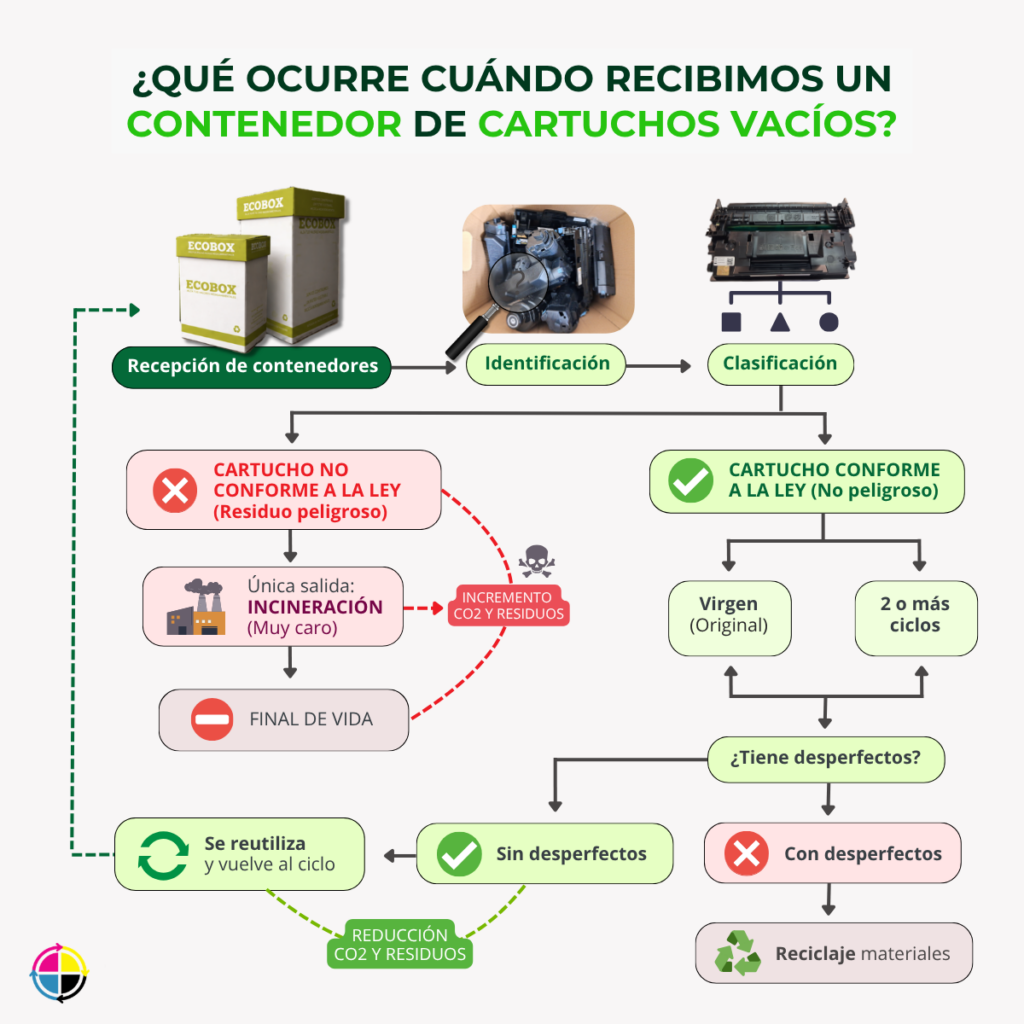
Every container we receive starts a sorting process whose objective is to maximize reuse while minimizing waste generation and CO₂ emissions.
🔵 RECEPTION AND SORTING: We inspect each cartridge to determine whether it meets the legal and technical requirements that allow it to be reused.
🔴 NON-COMPLIANT CARTRIDGES: These do not meet legal requirements and are classified as hazardous waste. Their only management route is incineration, a treatment with a high economic and environmental cost that marks the end of their service life.
🟢 COMPLIANT CARTRIDGES (non-hazardous): These are sorted according to their usage history (virgin or with two or more life cycles) and inspected to assess their condition.
♻️ REUSE AS A PRIORITY: If the cartridge shows no damage, our priority is always to reuse it, extending its service life and returning it to the usage cycle.
🔄 MATERIAL RECYCLING: When a cartridge is damaged and cannot be reused, it is sent for material recycling, allowing the recovery of raw materials before the end of its life cycle.
The circular economy is not just about recycling; it is about keeping products in use for as long as possible.
⚠️ NOTE: To ensure a safe, traceable process that complies with our quality standards, we only accept original (OEM) cartridges and remanufactured cartridges based on original OEM cartridges.
Compatible or clone cartridges are excluded, as it is not possible to guarantee their origin, composition, traceability, or compliance with the technical requirements necessary for reuse.
#CircularEconomy #Reuse #Remanufacturing #Sustainability #Consumables #WEEE #WasteManagement
04 de agosto del 2026
